Showing posts with label Thoughts. Show all posts

Friday, 27 August 2021

This years one and only real ITS 12 tournament

Our local group again used the better Covid-situation during summer to run a small real life tournament. With all the vaccination going on and a great, private location, we were able to invite some of our friends and not only get some real life experience, but also different players. Of course, what counted most: Meeting each other and moving your lovely metal-miniatures along the board!

Since I am looking for ways to change and improve my post-game writings, this tournament-report will also be a first trial for some competetive analysis. The goal is to look what plan existed before the game, how it could be implemented during the game and which circumstances lead to success or failure.

The missions for the tournament were Supplies, Firefight and Mindwipe (in that order, since I like to torture my attendees from time to time). Depending on what you like to play, you can easily build a list for Supplies and Mindwipe, since you need fast specialists in both cases and AD troops are viable, too. But also Mindwipe and Firefight match quite well, if you want to focus on a more aggressive style. This also leads to a situation, where players could take one list they are familiar with after this long break.
I missed to stay up-to-date with the latest TTS-meta and what factions are played most, but I expected some O-12, Hassassins and Nomads as most chosen factions among the 10 participants. Nevertheless, Haqqislam wasn't chosen once, Nomads were very popular and heavy armour in form of Invincible Army and PanO seemed to be appealing, too. I was the only O-12 player there with the following lists:

 Firefight
──────────────────────────────────────────────────

GROUP 1  10  / 1  / 1
 CRUSHER (Combat Jump, Parachutist) Boarding Shotgun, Panzerfaust, D-Charges / Pistol, E/M CC Weapon. (0 | 36)
 ANDROMEDA (Infiltration [+6]) Submachine Gun, Zapper, Flash Pulse, D-Charges / Breaker Pistol, DA CC Weapon. (0 | 33)
 ZETA (NCO) Hyper-Rapid Magnetic Cannon, Heavy Riotstopper / AP CC Weapon. (2 | 81)
   ZETBOT Flash Pulse / CC Weapon. (0 | 0)
 CHO (Lieutenant) Combi Rifle, Nanopulser / Pistol, CC Weapon. (0 | 15)
 FUZZBOT (Minesweeper, Repeater)  ( ) / PARA CC Weapon(-3). (0 | 8)
 KYTTÄ Flash Pulse / PARA CC Weapon(-3). (0 | 7)
 EPSILON Heavy Machine Gun, Nanopulser / Pistol, CC Weapon. (1.5 | 34)
 VARANGIAN Submachine Gun, Chain Rifle, Smoke Grenades / Heavy Pistol, AP CC Weapon. (0 | 12)
 BLUECOAT Submachine Gun, Heavy Riotstopper / Pistol, Shock CC Weapon, PARA CC Weapon(-6). (0 | 16)
 BLUECOAT Submachine Gun, Heavy Riotstopper / Pistol, Shock CC Weapon, PARA CC Weapon(-6). (0 | 16)

GROUP 21
 VARANGIAN Submachine Gun, Chain Rifle, Smoke Grenades / Heavy Pistol, AP CC Weapon. (0 | 12)
 GANGBUSTER (Minelayer, Hacker, Killer Hacking Device) Submachine Gun, Madtraps ( ) / Pistol, CC Weapon. (0 | 22)
 KYTTÄ Flash Pulse / PARA CC Weapon(-3). (0 | 7)

 3.5 SWC | 299 Points
Open in Infinity Army

I wanted to create a single list for Firefight with the lowest specialist-count possible without loosing much safety in it. While I more and more tend to a defensive play with O-12 and Varangians as well as Crushers don't use SWC, I often don't fully use them. The whole plan with this list is to present big threads, each with unique specifications. Ideally the opponent gets puzzled with that, loosing his threads to my pieces they are not suited for. And while Andromeda and the Zeta draw as much attention as possible, the Epsilon and the Crusher shall catch juicy targets off guard and score the points. To not get alpha-striked, a deployment which only makes you visible in your own half of the table, Andromeda as first roadblock and the Gangbuster as a second one are key. Only the classified-situation may turn out a bit difficult, since there is no doc and no engineer. This should be compensated mostly by the Crusher, but also the Gangbuster, Andromeda and Epsilon should be able to cover most of the classifieds I can't dismiss in the beginning.

Supplies Solo
──────────────────────────────────────────────────

GROUP 1  10  / 1
 CRUSHER (Combat Jump, Parachutist) Boarding Shotgun, Panzerfaust, D-Charges / Pistol, E/M CC Weapon. (0 | 36)
 VARANGIAN Submachine Gun, Chain Rifle, Smoke Grenades / Heavy Pistol, AP CC Weapon. (0 | 12)
 EPSILON Heavy Machine Gun, Nanopulser / Pistol, CC Weapon. (1.5 | 34)
 RAPTOR Spitfire, Light Flamethrower / Pistol, CC Weapon. (1.5 | 43)
   DEVABOT Heavy Flamethrower / PARA CC Weapon(-6). (0 | 5)
 DAKINI Tacbot (Paramedic) Combi Rifle ( | MediKit) / PARA CC Weapon(-3). (0 | 15)
 GANGBUSTER (Minelayer, Hacker, Killer Hacking Device) Submachine Gun, Madtraps ( ) / Pistol, CC Weapon. (0 | 22)
 ALPHA (Lieutenant [+1 Command Token], Strategos L1]) Light Shotgun, Nanopulser / Pistol, DA CC Weapon. (0 | 24)
 LAMBDA (Engineer, Deactivator) Combi Rifle, D-Charges ( | GizmoKit) / Pistol, CC Weapon. (0 | 16)
 YUDBOT PARA CC Weapon(-3). (0 | 3)
 LAMBDA (Doctor) Combi Rifle ( | MediKit) / Pistol, CC Weapon. (0 | 16)
 YUDBOT PARA CC Weapon(-3). (0 | 3)
 OKO Combi Rifle, Flash Pulse / PARA CC Weapon(-3). (0 | 16)

GROUP 21
 VARANGIAN Submachine Gun, Chain Rifle, Smoke Grenades / Heavy Pistol, AP CC Weapon. (0 | 12)
 KYTTÄ Flash Pulse / PARA CC Weapon(-3). (0 | 7)
 KYTTÄ Flash Pulse / PARA CC Weapon(-3). (0 | 7)
 RAZOR (Minelayer) Boarding Shotgun, Shock Mines / Pistol, CC Weapon. (0.5 | 32)

 3.5 SWC | 298 Points
Open in Infinity Army

While the backbone and defensive plan is the same as in list one, I traded the redundant attack-section for more specialists. The Raptor as well as the Epsilon are reliable door openers to guarantee that I will be able to grab at least two boxes early in the game, supported by the opportunities Alpha's Strategos may offer. To grab the boxes there are three fast specialists available (Gangbuster, Dakini, Oko), which also have a second role by themselfes. The Oko should be able to get me around camo-markers on the crates, the Dakini may deliver a medikit on the Raptor or the Epsilon in the midfield and the Gangbuster may scare some hackers away or glue someone on the crate with the madtrap. A backup are the Lambdas. Most of the time they should keep my defense and attack running, but if needed, they could clear some mines or grab a box. If I would go second, first the Razor should block one box away with his mine, then the Crusher should kill whoever secured a box in the enemy half.

But how did it turn out?

Game 1, Supplies vs. Corregidor


Corregidor seems to be the new hacking-monster with Jazz and Morans and so it came that I faced Jazz in a full link, several camo-markers, one in a nasty ARO-position and a smart missile launcher. Since I haven't played against Corregidor for a long time, I promptly forgot that there will be McMurder. I went second and got my deployment of the Raptor and the Alpha messed up by two repeaters out of my LoF, even if no missile was shot and my Alpha dodged like a king against an overwatching Intruder HMG. Nevertheless I was quite locked and turtled myself up, just killing stuff crossing the centerline. My opponent grabbed one box, handing it to an EVO-drone in his deployment and denied the other two. With a coinflip of landing my Crusher next to the EVO, I turned the game in the last round and won it with one to no boxes.
There was no glory for me in this game, just defending as long as possible and abusing one massive mistake made. If there would have been a second box grabbed by a Bandit or something else, I would have been screwed. I pretty much know how the guided-missile-game is played, but Corregidor is able to add so much other stuff as support or distraction, that it is really hard to counter it or give the pressure back. Morans are really strong...


Game 2, Firefight vs. JSA


Ah yes, JSA. Nothing good to trade up in Firefight, since everything is damn cheap and even more annoying. I got the second turn and saw Yoyimbo and an O-Yoroi deployed, while I messed up my choice of side again. I too often forget to consider cover for my TAGs, even if I only have lists featuring one. So the Zeta stood in LoF to the O-Yoroi directly. Andromeda couldn't counter him due to the coalas and the high CC. It took far to less orders to get the Zeta down, but at least Yoyimbo died fast. Everything I threw on the TAG bounced off until turn three, while I could smoke up the left flank for cheap with a Varangian. With a last push the TAG went down, scoring me not only the victory points itself, but also a killed Lt. This came down to surviving points, where I had three more, so again a really close game which was turned accidently by me to a win.
If there are AP-weapons on the field, your high-arm units will still die directly and you now really have to consider CC, since the new dodging gets everything close to everything else. And if you don't have AP weapons or have them only for CC, your plan was bad. If you have a look on the played TAGs and HIs now, most of them have at least a decent CC, if not MA2-3, so that your D-charges are no safe solution. For everything else a Varangian with chainrifle will solve most of your problems, since it cuts through many defensive strategies (at least if viable targets are around) and most of the time gets two orders to kill stuff thanks to dogged.


Game 3, Mindwipe vs. Nomads


And all of the sudden, I played the top-table. From the previous games I knew that there again will be a TAG, but for vanilla Nomads, that does not seem to exclude any other tools or strategies, so that I faced an extremely flexible list with Puppetbots, an Überfallkommando, hackers, Morans and camo-markers. I had to dig my way through Pi-well, Szally, Pupniks and a Moran, which lead to horrible losses in my active turn and an expensive activation of the console with my Dakini. Thanks to the Raptor and the Kyttas, I was able to defend my servers a bit, even with nothing to push further. But with the time running, the Raptor went down and the Pupniks finally smoked the server up, while Szally cut through everything else. My opponent here played quite clever, since a Liberto and some other combirifles were used to defend the own AI-server. This time my hail-mary failed with the Crusher eating two mines without tanking anything on his way to blow up the server.
This is something, I would call a bad match-up. Nomads are the flexibility per-se, where there is everything quite cheap and well equipped, while O-12 is specialised to the top. While my defined soultions for single situations may cut through one or two problems, they are cleared by the hundred other things not prepared for. Of course it needs a good piloting on the nomad-side, since everything may die easily if sent into the wrong target or positioned not in the best way, but then this really is a top-tier player.

So, what are the conclusions? First, the tournament showed, what we all already know: Armour now has a real value and CC is more frequent than before. From what I have recognized, even 10-order lists are performing not that bad, as you may expect from the changes to "limited insertion"-lists. An other point to consider is the thread of pitchers and hacking in general. Since this equipment bypasses LoF, even in a non-lethal way, hacking areas and places to deploy repeaters may something to take into account while setting up some tables. But far more important here is the amount of scatter terrain. Our tables tend to be slightly overfilled with small crates and similar stuff, where you can stand behind and get cover, but also have LoF. This created the situation, that especially heavy targets became even more annoying to be removed. Even with AP, each spitfire-hit becomes a coin-flip against Arm 3-targets in cover, so it may be a term of balancing to don't have cover everywhere.

Regarding my games and list-performance, I should be quite satisfied but am not directly. The two wins were last-minute actions, where mistakes, luck and only the skill of managing losses piled up. I still suck at alpha-striking and developing my board-position still is a bit difficult, but the defensive style did not turn out that bad as expected or experienced in N3. After the last game, I got the idea of a 'blob' list, which soaks up attacks turn one and two and plays the best card in the late game, where there are holes and the opponent isn't that focussed anymore. This needs several roadblocks, something to keep the orders alive, one or two gun-fighters to remove important threads and two fast and flexible winners, like the Crusher in the recent lists. So that will be something I will elaborate further, hoping to get over the paradigm of alpha-striking everything in N4 as the only win-condition.

Nevertheless, I scored the 4th place, overtaken by Shasvasti due to 6 more OPs. From what I read between the lines and had overheard during and after the tournament, everyone had a great day and it was a real pleasure to be back at the table and meet all the great guys from Lower Saxony again, even if it was only a small circle. Probably the first bigger event will be organized in spring 2022, if things won't escalate during winter, so we are looking forward to ITS 13.

Friday, 30 July 2021

How to start on tournaments

Thanks to more or less good developments of vaccination-rates, at least ideas and thoughts about real life tournaments are present. Even with the pandemic the community grew, so that now new players ask themselfes, if torunaments are the right place for them and how to start with them in the best way, but also experienced players may want to refresh their memory. This shall be the startig point for this guide on how to start on tournaments! First I want to give you an overview about where to find tournaments in your area and how to subscribe to them, followed by tips for the strategic planning for the tournament, leading to the tournament-day itself, so that you can fully focus on meeting new people and having some great games of Infinity.


 1. Why visiting an Infinity-tournament?

Maybe you already have some experiences with tabletop-tournaments or you are completely new to the topic - A tournament itself always implies a certain competetivety and with that some stress/challenge. So if you are not very experienced with Infinity yet, why should you directly join a tournament? From my experience, Infinity-tournaments are something special and just the aspect of connecting to the community and meeting each other to have some games in a row is all of the deal. Even if you are new to a community, you are always welcome and your current level of experience is taken into account, so that the more experienced players often talk you through the game after it is done and show you some new tricks. These new tricks are also a good argument for joining a tournament. It seems like there are no two communities playing the same Infinity and everyone gets stuck to some routes of playing from time to time. In a tournament, you will meet different players and see different approaches and game plans and also get some misunderstandings on rules corrected. You can't learn more than on a tournament. An other aspect are the more or less secured set games you will get. While you get in one or two games per game night, on a tournament you will have at least three games and a complete day dedicated to the hobby, so you can really dive into it and enjoy this time. In conclusion there is no need to be worried about a high level of competetivity or some kind of gatekeeping. Moreover you will get to know many cool new guys and ways to play Infinity and enhance your experience.

2. What is an Infinity-tournament?

Before we dive deeper into the topics about tournaments, a short description of the overall system and what you may expect shall be given. Tournaments for Infinity most of the time follow the official ITS-rules (Infinity Tournament System). These rules are updated annualy with seasonal extras and slight changes to the mission set. It also adds some additional rules. For the moment we are in the 12th season, which will end in late September and will reset the official ranking. Each tournament following the ITS-rules can and should be reported in the official system (OTM), where your own ELO is calculated and your ranking on different levels is done depending on the number of tournaments played and of course your scoring. In most cases you will play the ITS-missions by default on your normal game-nights, so you will already know most of them. Nevertheless some tournaments will add one or more custom-missions or missions from previous seasons. The missions themselves are not changed. One special thing of ITS is the opportunity to bring two lists to the tournament. Both lists need to be from the same sectorial or vanilla-list but may contain completely different profiles, which will be discussed later. You may play both lists in the tournament but you don't need to. This adds a great opportunity to have the right tools available for each mission and evens out some scisor-rock-paper moments you may know from other tabletops.
Besides the rulewise factors, there is the event itself. Tournaments tend to be organized as one-day events with three rounds or as two-day events with four to five rounds. In Europe most two-day events have three games on the first day and two on the second and are held on weekends. One-day events are also organzied on weekends, mostly on Saturdays but also on Sundays. Depending on the organizer smaller events will be held in private rooms, local game stores or community-rooms with eight to 24 players. Bigger events may also be held in bigger locations. Most of the time a certain kind of catering (coffee up to lunch) is given or at least there are places to get some food nearby, so that you won't starve on a whole day of gaming. In most cases you don't need to bring terrain by yourself since the organizing team has enough terrain by themselves or someone else will also bring some terrain, leading to good and consistent maps in most cases. To pay for catering, the room and prizes, one-day events are priced around 10€ per participant, while two-day events are more expensive, depending on what is added to the whole event.

3. Finding tournaments

Infinity-tournaments of differenz sizes are held in many regions of the world, while the density depends mostly on the number of players in the region. Normally most urban areas have at least a small community, which has a WarCor or other motivated members, organizing tournaments from time to time. So the first and most important way to find local or regional tournaments is to connect with your local or regional community via messanger-apps, facebook, table-top forums or whatever community-place there may be. If there is a game store nearby, you probably could ask there, if they know about Infinity-players in the region.
To search directly for tournaments, the official tournament manager from Corvus Belli is your best friend. There you not only have to subscribe to a tournament and register your lists, which will be described below, but also can search for organized ITS-events. Since most of the organized tournaments will follow the ITS-rules and will be officially reported, they should be listed there. Only some may be missing, mostly smaller, more or less private events or tournaments which are organized via an other software and will be reported later.
Many tournaments then are shared via regional platforms like T3 in Germany, facebook (national groups, continental groups,...) or over forums. Maybe there are hobby-forums where you can also look, depending on where the national community is mostly organized around. Greater events are also often shared in the official Corvus Belli forum.

4. How to prepare for a tournament?

The preperation for an upcoming tournament maybe is the most important part, since here you set directions for your success and your enjoyment in the actual tournament. This covers of cours your list and the practice, but also the soft-factors and surroundings you should take care of. But lets start with the crucial points: Your lists and your practice!

What makes Infinity-tournaments special is the opportunity to bring two lists instead of just one to the event and don't be forced to use both of them. On the one hand, this makes the preperation a bit more difficult, since you need to build and practice two lists, but on the other hand it helps you to reduce the stress of only one list. Here you are able to to prepare one list for one set of situations and have a second one, which covers the other situations (missions, table set-ups, opponents,...). But what is now the best approach to list-building?

As you already know, Infinity is a game of playing to the objectives instead of killing whatever moves across the table. In a tournament, you want to score as many tournament-points (TP) as first score, objective points (OP) as second score and victory points (VP) as third score. Especially the new scoring system of season 12 implies that it is always a good idea to score as many objective points as possible, so the most important requirement for your list and the practice is to fit to the played missions. For this you need to know what missions are played and what are the win-conditions of these missions. There are several ITS-go throughs and mission-focusses available on the internet for your help.


Once you know what is needed to score points in the played missions, the big question is, how to build your lists in regard to this. In most cases you start to build one list, which will work well in one part of the missions, while your second list will cover the rest of the played missions. But there may be occasions where missions are quite similar or your first list turned out very flexible. In this case you could build a second list designed to cover a table set-up your first list may won't fit well (open terrain/dense terrain), or a certain list-archetype or faction your first list will have bigger troubles against (camo-spam, TAG-lists, guided-missiles,...). This one is a bit advanced, since you need to know the strength of your first list very well and you need to know when an opponent will pick one of the uncovered lists etc.. So I would advice you to focus on the missions for your first experiences.

Before you now start clicking together all you need and find interesting, pay a little attention to what you have already played some times and what you are familiar with. Of course that may be something sub-optimal, but in the end you at least have an idea how to use the pieces with the expected outcome, while new toys may need extra concentration and practice to be used properly. While looking back at my first tournament-games, I had to focus a lot to at least play the game in a way I normally do and not screwing completely due to exitement. Maybe you are more focussed (I really wish you are), but nevertheless experience is king here, so stick at least to some extend to what you already know!

In the best case, you don't go alone to the tournament and have one of your regular opponents ging there, too. This gives you a good opportunity, to practice your lists and the missions before the tournament to get a better feeling and understanding of how the mission works and how your list works to this. From my experience especially the missions play quite different than you read them and to get the right timing for clicking the buttons and stop killing stuff often needs some practice. Based on this, I would advice to try and practice each mission at least once. This gives you an idea of what will happen and you will have played each list at least once. If you don't have the time for this, focus on the most unfamiliar things. If one mission-type is completely new for you, practice at least that type once. If you play a quite unfamiliar list, have at least one game with that list. The goal here is to give you a bit more auto-pilot-feeling in the tournament and reduce the impact of nervousness.

 
Besides this, there is a list of items you should prepare before the tournament. This should help you as a check-list:

  • Arc-marked miniatures (all of them in some way, but in a clear way!)
  • All tokens you may need in the needed number (unconscious, prone, wounds, orders, ...)
  • Silhouette-markers, since you will see new terrain and want to check LOF reasonable
  • Measuring tape
  • 5 D20 dice
  • Printed out version of your lists
  • Printed out versions of the responding courtesy lists
  • All miniatures and maybe holo-decoys you may need (including HVTs)
  • Classified deck
  • Comlog-app on your smartphone
  • Pen and some paper to note hidden information etc.
  • Something to eat and drink for yourself to stay energized

5. The tournament itself

All of the previous advice and the few following only lead to one, very important advice: Have fun and enjoy the tournament! Many struggles and problems may be already dealed with, so now there are only a few to keep in mind on the big day.
Arrive in time, better a bit earlier than too late. Infinity-tournaments life from no long speeches and introductions as well as a more or less calculatable time-table. So if you arrive too late, you either create a delay in the whole timeplan or you will miss some important information and clarifications on the tables etc. But even more important is that you will miss the chance to have a chilled arrival, grab your first coffee and have a chat with the participants already there, talking a bit through the tables or ideas you had during practice.
The time-table is also the most important thing to keep in mind but don't be stressed about. If you look at the schedules of the most tournaments, there is only a little lunch-break, while the rounds flow into each other. Most of the time, one round will have a duration of 2 hours and 30 minutes, translated in 30 minutes for deployment for both players and one hour playtime for each player. Sometimes chessclocks are used, but not that often. Thanks to your practice, you will be able to direct your lists through the game in the given time, since you may have a plan, know your rules and don't have to look everything up. In my experience, the time is long enough, if you are no really slow player. If that is the case, you should add some practice to get your games done in 2 hours 30, which will also benefit your regular gamenights. Often your games will end much faster than expected, since the outcome is clear and everybody played their hands, adding the needed and wanted time for some snacks, coffee and chats with your opponents and the other players. So you don't need to fear starving or having no time to get to know new people.

Hopefully I could answer some questions regarding Infinity-tournaments with this guide and give you an idea about those events and why to join them. Some aspects around missions and list-building are described elsewhere way better than I could give it in this guide, so check out all the other ressources available (Bromad Acadamy, The Dice Abide, Goonhammer,...). Nevertheless, let me know if you have further questions, want to share your experiences or have something else to share to this topic!

Sunday, 27 December 2020

Countryside Infinity Terrain Guide: How to get your map together

After reading all the different points and thoughts about terrain in Infinity, you are hopefully eager to build your own terrain. In this last part of the guide, I want to give some different ways to get your map together a closer look. Since the cineastic and strategic experience of Infinity is strongly related to the terrain you use and it can impact the game in many different ways, as we discussed before, it is important to get the right terrain pieces to hand for your game. With the introduction of 3D-printing, lasercutting and a bigger community, the market of terrain in general and pieces designed for Infinity has grown a lot over the past years. But besides this, there are many opportunities to let your own creativity and hands flow and build things on your own. While I am not a great terrain-builder and especially painter on my own, I want to focus more on the general aspects of different kinds of terrain, like what do you have to take into account when using it and for whom it would be good to use.

A general wrap-up

Before we discuss different options to get your map together, we should recapitulate, what we need. Since line of sight is an important thing in Infinity and everything dies instantly if it is seen from too many positions, you will need solid terrain to block firelanes. In most cases, you should cover at least 50% of the surface with terrain to block firelanes. This may be not correct for some special situations, but you can keep it as a rule of thumb. Once you have broken up firelanes on the ground level, you need some more pieces to structure the upper levels of your map, creating elevated positions to shoot from and blocking firelanes all over the same level. The third important part for your map is the smaller scatter terrain, including all the stuff you can throw into the corridors, on the roofs or wherever you need some more cover. Besides these three essential parts, there are some special terrain pieces you can include in your map, but you don't need to.

The different ways to get your terrain

Papercraft

The easiest and maybe cheapest way to get a majority of your terrain together is using papercrafted terrain. Since the terrain produced by CB directly and used in the old and actual Operation-boxes is based on paper, too, I will include it in this category. The other options here are self-printed and assembled pieces, or premade kits purchased from somewhere. The community already created a lot of general templates for different buildings, walls and even scatter terrain, which can be downloaded for free of for a small tax, but if you want something more sophisticated, you will need to look for special producers like CB or something different in the internet.
If you have found something suitable for your needs and want to start, the only things you need are a reliable printer, some ink, a scissor and fitting glue. Depending on the paper you use for the prints, the terrain will be more sturdy and you may be able to deploy heavier models on it to the cost of material-flexibility. But besides printing and assembling, there is not much work to be done until you can have the first games on your map, since the whole painting-step is already done.

Papercraft terrain in general has the following pros and cons:

+ cheap
+ easy to produce
+ big quantitity of bigger terrain pieces in no time
+ easy to store

- persistence of terrain under constant use
- stability when using metal miniatures
- light weight terrain (easy to displace during the game)
- papercraft-look
- takes a bit to set up

Icestorm

Until the release of Code One and Operation Kaldstrom, each Operation-Box for Infinity included a terrain pack of pre-painted papercraft terrain, consisting of four buildings and four to six containers, depending on the set. The buildings were discussed in the previous articles, since the smaller ones have the problem of being smaller than S7 models. But besides that, the whole terrain is easy to use and to scale up for a whole map. To build an interesting map for a 48x48 map, you will need at least four of these packs, where five or six will give you more opportunities. The combination of containers and buildings let you create different situations and break up most necessary firelanes.
Only the stackability of the buildings is a bit challenging, since they don't fit on each other to 100%. A bit of adjustment from your side may solve the problem. The stability of the terrain is quite okay for papercraft and can be increased with easy to build or to buy inlays for both pieces. This also may solve the weight-problem, since the pieces are normally quite light and easy to move.
If you keep the terrain flexible, it can be stored easily and without much space needed, but even if you don't disassemble the terrain after a game, it does not need to much space. Thanks to the regular shapes, it fits easily into storage-boxes. I would advice to keep the terrain assembled to reduce the impact on the material. The persistence of the material and the paint under constant use is quite good. My set is used constantly over the year and shows no bigger problems after more than two years now.
In summary you will need something about 100€, a bit of adjustment and a bunch of additional scatter-terrain to have an easy to store and to set up map.

An example of the Icestorm paper-terrain, where the higher building is slightly modified to stack better.
A block of polysterene connects the two single buildings to avoid anything crashing through it or the buildings falling apart.

A piece of fiber slab or a filled cardboard-box from CB can and should be added to the terrain to improve the stability and weight.


Kaldstrom

Witht the release of Operation Kaldstrom, CB introduced a new set of papercraft terrain. Compared to the former sets, it is improved in many ways. Instead of normal paper, thick cardboard is used, enhancing the stability, weight and persisctence. Also the content is changed. Now not only containers and buildings are included, but stackable buildings from different sizes and different kinds of scatter terrain. These positive changes nevertheless resulted in two disadvantages: The prize increased by app. 10€/set and the assembling seems to be way more difficult. To avoid damages during the assembly, check out Youtube for some tipps and tutorials!
While the old papercraft-sets were quite uniform in pieces and design, this is now changed. Not only that the variety in the core-set is increased, but there are also expansion packs with completely new pieces in it, like an objective room or some sniper-towers. This will allow you to create different kinds of maps with a basic set of pieces and single special ones from the expansion packs, depending on your needs.
Since I don't own this terrain by myself, I have no first hand experience about storage and persistance. The community advices something like four to six sets of this terrain to fill a 48x48 map, resulting in total costs for your map of app. 150€. Since the shapes of the terrain are still regular and the smaller pieces may fit into the bigger ones, it should be easy to store and easy to set up. 

Papercraft

For every other papercraft-terrain the pros and cons of the different CB-versions may also apply. In general, I see two possible approaches for papercraft-terrain: easy to store and easy to produce paper-terrain and persistent cardboard-terrain. Cardboard-terrain will live longer and will be easier to set up for the daily use, but will also be more difficult/expensice to produce and a bit more difficult to store, since you can't disassemble it easily and have to store it in bigger boxes. The easily printed and assembled paper-terrain on the other hand can be disassembled easily and so stored in quite small boxes. But this will force you to assamble it before every game and disassemble it after it, what will take a while and stress the material. Also it is easier to be deformed by use or storage over the time. Nevertheless, if you want to get started and make your first expriences, it is a great way to set up your first maps and then switch to other terrain-types.

An example of papercraft terrain, printed from some files of the internet on slightly thicker paper.

This box fits enough papercraft terrain for a whole 48x48 map.

MDF 

Most of the maps you see on social media (and even on TTS, thanks to the community) consists of laser-cut MDF-terrain kits. The market for those kits grew extremely over the past years and even free files to use with your own or rented laser-cutter get more frequent. Not only the whole amount of general sci-fi MDF-terrain is growing, but also special designed for Infinity-sets become more frequent (like from Warsenal, TTCombat or Micro Art Studios). This allows you to select the terrain fitting to your ideas and needs.
The kits come unassembled in a kind of sprue and need to be assembled, glued and painted. The overall quality of the kits is good, but sometimes you need some refinement during assembly to make everything fit perfectly. Painting may be a bit difficult if you don't own an airbrush or are experienced with spray paints, since the kits get more and more detailled. But even if you have to work with brushes, there are several tutorials for this on Youtube to help you with this issue. If you don't want to paint the terrain, there are some pre-painted kits on the market.
Most of the suppliers not only sell a variety of normal terrain, but also additions and special pieces, as well as scatter terrain. So you can purchase everything you need for your map made from MDF. Depending on what you want for your map, you will end up between 200€ and 350€ for the terrain and about 50€ for rattlecan paints, adding to some time you need for assembling and painting.
For this advances price you will get a good looking and interesting map. Due to the material-properties, all pieces have their own weight, limiting the potential of displacement during the game. Also, assumed a proper sealing of the paintjob, the persistance of the terrain normally is quite good and will guarantee several years of use (I have not seen any teared down MDF-terrain since now). Since there may be different shapes of the pieces, storage can be a bit challenging. This strongly depends on the series you choose, since there are also very easy to store kits, which can be stored easily in smaller boxes, including even the scatter terrain.

So if you don't have the time and/or creativity to build your terrain by yourself, but want an interesting Infinity-map, MDF-kits are the right thing for you. Just consider the needed time for assembling and painting all the terrain during planning. Since you can choose individual kits for your own map, don't plan to short. Many suppliers actually advice how much space you can cover with the kit, so you can plan more easily for how much terrain you will need. But most of the time, you want to reduce the amount a bit to safe time and money, but will end up with a to open map and less fun to play. So plan with the right amount of ressources!

There are many different MDF-kits available on the market, so that there are basic pieces of many kinds of maps.

3D print

Not only lasercutters are becoming more and more frequent in the hobby, but also 3D-printers for private use are a real thing now. These machines allow everyone to print everything out of thermoplasts or resin what you want - in theory. In theory, you now can design your whole map on the computer and then print it on your 3D-printer, put it together and paint it for the costs of the printer, the energy and the material. If you are used to computer-stuff and have some experience with vector-graphics, this may be your approach and in this case, 3D printed terrain may be the best solution for you. But in most cases the steps before it comes to the printing itself cause you some troubles, since most of us are no technical experts in this topic. Desiging your own terrain as printable files then is very difficult and rarely possible, while getting the printer online and working should be doable with some time to try out. Luckily the internet can solve the first problem for you, since it offers free and purchasable pre-made files you can use for printing. Over the past years there were many kickstarter-campaigns creating unique sci-fi files, but you can find a lot on pareon and thingiverse these days. If there is something fitting your needs, you have a great point to start. But even if you have found the files, you need to get them running and fit on your printer. In most cases, you will have to print smaller parts and put them together afterwards, since the private printers won't allow to print quite big pieces in one go. So in the end you will end up with okay-ish costs for your project but maybe the biggest time-investment of all options you have.
Once you have overcome the technical issues, you may get not only a nice looking map, but also terrain designed to use in wargaming. The material used will give most pieces enough weight to not be moved by accident and is sturdy enough to endure transport and storage, but also many games. Like wood or MDF, the material will be thick enough to let heavy pieces be placed on roofs and so on, at least of you have printed them thick enough.

On a side-note, 3D-printing may be the easiest way to create tons of scatter terrain and objectives like tech-coffins and antennas. So even if you don't want to print your whole map, take this option into account when it comes to the smaller pieces.

Selfmade

Depending on your idea for the map and all the other circumstances (time, money, motivation, creativity, talent), a selfmade map can also be an option, maybe the best. To generalise a bit on this topic, you can achieve the best results for your terrain with this 'method' and also with the lowest costs, for the sacrifice of time, creativity and talent. But since the last three points most of the time are the fun-part of the hobby, building your own Infinity-map is the coolest thing to do! In many cases you are forced to go with this, since not every setting can be done with MDF or 3D-printers. On the other hand you are able to create all the things you need, you can imagine and you need rulewise to allow the best interaction during the game. 


Since you can use different materials for your terrain, the persistance may vary together with the needs of storage. Normally you will build more detailed pieces with less durable materials or designs, so that you have to decide on your storage-solutions. If you store each piece individually, nothing will break but you need a lot of space. If you are short on space and have to put everything in one box, details may collide and irregular shapes won't match each other, so that there will be damages. On the other hand you have the chance to design everything in a way to match your own storage- and transport-situation.
 

The choice of material not only affects the persistance, but also the difficulty of production and the costs. The cheapest but also most fragile material may be cardboard. It is available for free in your trash, can be cut easily but is less durable when it comes to contact with other terrain and use.

Some hot-glue and cardboard from packaging can be brought together easily for basic buildings.

Many cardboard materials appearing in your flat can be used for Infinity-terrain. Just glue the boxes together and shield it with blank cardboard to even the surface and create ceilings.


More flexible and durable, but also a bit more expensive, is foamboard or whatever this material is called in your locallity. Here, I refer to polysterene blocks, which can be cut with a sharp knife or a hot wire (Proxxon Thermocut!!). The available tools allow you to cut many different shapes and things, so that there are no limits, once you are used to the tools. Problems with this material is the missing ability to use most of the rattlecan spraypaints directly on them, the missing weight of the material and the sensitivity to damages and breaks during the use and transport. A proper sealing may help you with all these issues. 


The most durable option may be solid wood, plastic card or plastic in general. These materials are not that difficult to use for basic shapes and things, but once you go for the details, you will see the limits. Depending on your supplies, this also may be the most expensive way, since you will have to buy everything and can't use things appearing in your flat.

Especially for scatter terrain, polysterene can be cut in many different shapes and sizes to create all the things you need.

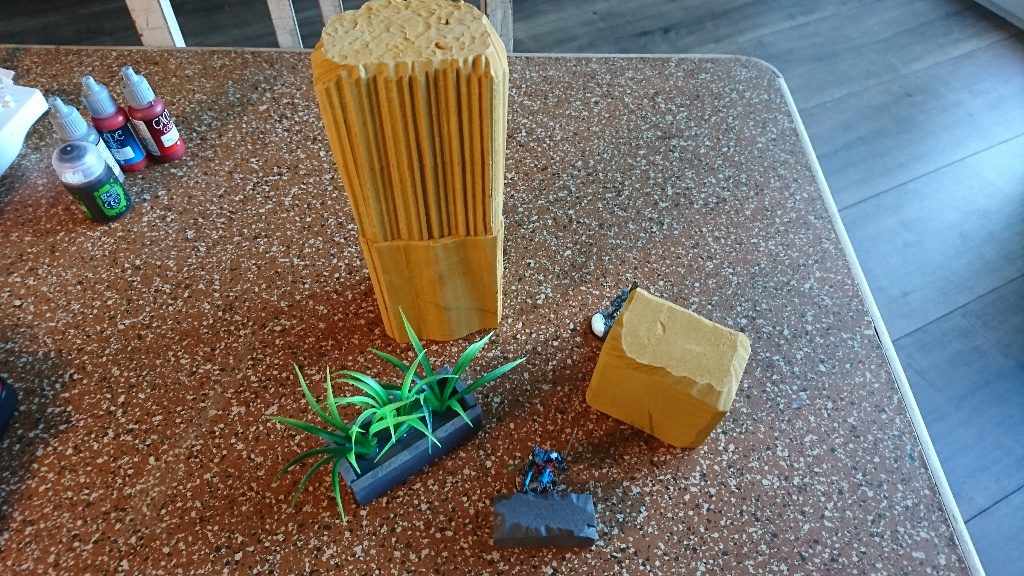
Simple polysterene-blocks can be used and fenced with different structures to create buildings of different style and size.

Most of the time you will end up with all materials mixed, creating the look you want. If you are not super experienced in this field, you will need some additional time to plan everything, collect the materials and prepare for failure. In most cases, not everything will turn out in the way you dreamed about it, so plan b is quite common and you should be aware of this. But nevertheless, in the end you will have some great hobby-time and end up with an unique map, fitting your needs and ideas about the game.

Polysterene-blocks of different sizes covered with some cloth and lots of PVA make good and flexible scatter terrain.

Planters made of caps (bottles, rattlecans) and filled with different kinds of moss are also a cheap and easy option to create your scatter terrain. You can fill it with some metal-pieces to gain the needed weight.

To summarize about this topic:
If you are new to the topic and want to try out different things or don't have that much money left, go for papercraft terrain, especially the sets designed directly by CB. They will allow you interesting basic games for a small budget. If you want to advance from this, the solution depends on the factors of time and money. If you are short on time/motivation, but are willing to spend something like 300€, MDF-terrain is your way to go. The internet is full of available and great kits, so that you can find everything you need, If you are short on money but have some time left and at least some motivation (talent is optional!), try to build your own terrain. The included pictures may give you an example of how simple those things can be. If you are searching for some high-level inspiration, you can check out the forums or social media. But in the end, all these solutions will be fine for your game and can be used to display all scenarios you want to play.

Sunday, 13 December 2020

Countryside Infinity Terrain Guide: The trade-off between rules and reality


Maybe the most exiting thing about Infinity is the stunning terrain you play your games on. Even if you don't own one of these premium tables, you can find them shared all over the internet and sometime will find the place, time and money to build one yourself. Unfortunately, the best looking terrain or the most realistic terrain may cause problems when it comes to the practical games, since the rules require certain considerations. To avoid the situation that you spent hours on your map and only see these issues in the first, long awaited game, I want to discuss these points in this part of the guide.

Cover

Before the cover-rules changed in N4, 30% of the actual silhouette of a model needed to be concealed to get cover. This set the height and width of most scatter terrain, since it was quite useless in game-terms, if a S2 model is not able to get cover while standing behind it. With N4 there is no given percentage, but only that a part of your silhouette is concealed by the terrain you are touching. In this case, the new edition lowered the error-potential while building the right terrain a bit. Before the planter you wanted to use as scatter terrain needed a specified minimum size and even if S2 would gain cover, the next S4 unit maybe won't get cover there. Now even a small water hydrant gives cover to everything hiding behind, even a Maghariba Guard.
In the same way, N4 changed the cover-rules for units on elevated positions. In N3, your trooper needed to be prone on an elevated position to get cover, or stand on any kind of handrail. While being prone on an elevated position limits your LoF in many ways and causes misunderstandings, handrails are not usable or nice on every piece of scenery. Not every roof is designed to walk on it, mointains or bigger rocks rarely have any handrails and whatever weird situation there may have been...Now it is solved, since you only need to be higher than the trooper you are interacting with. So your troopers can walk on any kind of roof and rock-formation you are planning. But before throwing away all your handrails, make sure to have other horizontal structures to grant any kind of cover against troopers on the same level.

Scarface on the right now gets cover from everything on the ground level. Thanks to the small planter, a part of his silhouette is covered even for things on the same roof. On the other hand, the Uhlan on the left has free sight on Scarface. Take this situation into account while setting up your map.

Placing

Besides cover as one former important point to consider for your map, the necessity to be able to place a model somewhere may be the most important thing to consider while planning and building your terrain. The issue of placing occurs whenever you are building any kind of non-standard terrain. Espcially if you want to work with rock-formations or anything similar, you need to make sure that every model you want to be there is able to be placed somewhere. It isn't that important anymore that the whole path is wide enough to fit the base, but to make terrain playable in this term, there needs to be a place big enough after a narrow path. This path should not be longer than 4", maybe in some rare cases 6", so that there are places where troopers can move to with their build in MOV. If this isn't planned properly, troopers may only cross the terrain with two short movements and have no opportunity to react to the AROs they will produce, since they can't legally stop their movement in the path. Nevertheless, you can always use this kind of problem to design paths not suitable for bigger units like TAGs or REMs, if you think this would be necessary.
One last thing to consider regarding placing issues are te highest points of your map. Sometimes you build rock formations or even buildings higher than the rest of your terrain. In most cases, this generates really fancy sniper spots, which can't be accessed from the ground. To avoid this, make sure to either design your terrain in a way that you can't place a model on this pieces, or that it is clear for everyone, that deploying there is forbidden. 

This hill is designed to minimize placing problems and avoid miniatures falling down. While Saito can be placed nearly everywhere here, Scarface can't legally take the current position, but cansimply vault over the hill to a position, where he can be placed.

Interaction

Rulewise models use and interact with terrain most of the time when they are vaulting over obstacles, climbing on things or jumping from one point to an other. While climbing and jumping are more or less designed to deal with specific terrain-situations but are quite order intensive in most cases, vaulting is the short-cut for this. Rulewise a model can move over or climb on obstacles without any restrictions, if the obstacle is not higher than the silhouette of the active model. In many cases you want to make your buildings and other higher terrain-pieces more accessable while also lacking some ladders to fulfill this role. For this situation, the vaulting-rule allow you to create easy access-points for normal troopers by stacking some smaller boxes or creating other stacked structures. This also adds new combinations for cover to your terrain. On the other hand you need to make sure that bigger units, especially TAGs can't go everywhere without any difficulties. This is an issue with the old Icestorm-terrain, since the buildings are slightly lower than S7 models, so rulewise every TAG can just move over them. While building your own map, take care of these two problems and choose the right height for your terrain.

The old papercraf terrain from Corvus Belli is slightly smaller than S7, so that TAGs can simply vault on the buildings and containers. Take this into account to determine where things can move easily and where not.

Line of fire

Of course, some of the previous points already interacted with different situations of LoF-issues, but there is an other specific one to point out. In many situations, you want to spice your terrain up with more irregular terrain, altering the standard box-shape. This can be a walkway, a forest or some kind of industrial plant. But while leaving the box-shape with defined volume, there will appear holes and unblocked corridors within the terrain piece. This is also valid for buildings with windows, where you intentionally can draw LoF through the whole building. I would assume that these kind of LoF-issues is the most common reason for arguments and kind of gotcha!-moments in Infinity, since it is played differently everywhere and so is up to interpretation.
This overall problem could only be avoided if you build complete consistent and clear terrain. Unfortunately, this will be quite boring in general and would let most of the beauty of the setting unused. So please continue building cool terrain, but I heavily recommend to try to design the terrain as clear as possible, considering the different possible interpretations and ways to use it and in the best case note some instructions to be handed out on the table.

This high pillar is a premium place for every stron ARO-unit and also fits at least S6 units. If there is no ruling or clarification about deploying there, you can break your game easily.

This building illustrates several issues with terrain and LoF. Not only that it is totally open on each side, so that units can draw LoF easily through it, it also shows how terrain which is designed to block LoF can fail with this, if you don't clarify it. Be clear about the use of real LoF or home-rules and take those possible LoF-issues into account.

Clarity

The previous LoF-issue may be the most common problem of clarity on Infinity-maps, but they can and will occur in every non-standard situation. If you took all the previous points into account while desgning your terrain, you will have avoided a lot of discussion. But nevertheless, there will always be situations where the exact ruling or practical use of a piece of terrain is not 100% clear. But since the game itself is quite complex and works a lot with pre-calculating interactions, uncertainities regarding terrain-pieces really should be minimized. To do so, try to design the terrain as clear as possible and wherever this is not possible or wanted, give some easy to understand advice or instruction to the players. To talk through a map before the game really should be the standard procedure for every player, but we all know how things go sometime. So prepare two papers with short instructions and store them together with the terrain. In that way, the information is always available on the map, when it is used for a game.

Sunday, 6 December 2020

Countryside Infinity Terrain Guide - Special terrain to spice up your map part II


The right representation

According to the rules, you need to define the zone for the special terrain you want to place. With this, it is easy to determine when you enter silhouette contact and when LoF crosses the zone or not. For your game, you should take care of fitting terrain-zones like cut bases or detailed ponds for example. But in many cases, some paper can do the trick, too. Without such a clarification, a lot of confusion and arguing can appear, limiting your fun.

While creating the zones, you have to determine the size of each zone. This decision has a big impact on how the terrain affects the game. Not only that you need the space to place bigger zones, but also the amount of LoFs crossing it are influenced by the size. Keep in mind that you don’t create classic full cover. You can either walk through it or you can shoot through it. And in most cases you won’t get any cover on it. If you have many small zones or some big zones of special terrain, the map may become quite open in many cases, or at least becomes too open if MSV-units show up.
Besides the area of your special terrain zones, sometimes it may be necessary to define the height of the zone. This won’t be necessary for difficult terrain, but once you work with visibility conditions and saturation zones, you need to define at which height the conditions may end. Once there is a LoF drawn unobstructed from one point of the silhouette of a trooper to another one, the effects of your terrain won’t apply and maybe arguments may start. So pay attention to your definition of height here to ensure that there is no space for arguments. Better define things a bit higher than needed, than defining them too short. 


In this case it is not directly indicated by the terrain, if the effects for shooting through apply for the Black Friar or not.


On the other hand, you can use different heights to create more interesting terrain pieces, like a cereal-field with S1 height as zero and white noise visibility conditions. Troopers may crawl through it unseen, while everything standing in it can be shot easily. 


This lower storage of the forest could be defined as S1 high zero-visibility and white noise-zone, to create new save paths.

To generally limit the impact of MSV units but also have some importance of visibility zones, I would advise to take a medium number of smaller patches for visibility zones. Planters are a good example here, but zones to the size of a circular template should also work, if it is limited to visibility and saturation. As a medium number you can take something around 3 patches of the size of circular template or five to six smaller ones.

Many small patches on the other hand will have no impact if you use them for difficult terrain. If they are too small, units can either simply go around them or cross them with one additional order. The opposite would be some large patches, at least of the size of a circular template, but most of the time bigger than that. The bigger those patches are, the more impact they will have. In most cases, two or three of those patches define clear zones where the special terrain determines the game, but also leaves some space for normal troops to be useful in the game.

If you combine both types, you either lose the impact of the difficult terrain, or create big patches without proper cover. It is a good advice to go with some medium to big patches of special terrain, if you want to combine different conditions. But then add some solid cover in these zones to limit the benefit for high-burst big guns on well trained or good equipped gunfighters. Place some solid rocks, where S2 units can hide in the zone or put some real trees in your forests. This kind of scatter terrain also allows you to create flexible fire lanes and break longer ones up where needed.


This map has four bigger forest-patches. Three of them define the narrow but more open left side, while the fourth seperates the two settlements on the right.

 
As there are trees placed in the forest-zones, not only solid cover is added to the zones to break up LoF, but also LoFs in the upper storage of the forests are broken, limiting some decent firelanes on this map


Next to the quantity and specification of special terrain, the placement is the third important factor, influencing the game. In general, you should use the special terrain to define what you want from your map. If there should be some spots with good LoFs to key-positions, you can place difficult terrain around that or on the path towards it. Or you can narrow bigger corridors down with difficult terrain, maybe with saturation zones, too. In this situation, terrain-specialists may have better access to this path, while the standard gunfighters and ARO-units are weakened.

In general, it is easier to break the game with the wrong quantity of special terrain, rather than breaking it by a wrong position. But again, you don’t create solid cover, maybe the most important thing in Infinity, by placing special terrain on your map. This means that you can’t replace your basic terrain with special terrain. Even with tons of special terrain zones, a too open map will stay open and hardly balanced in most cases. But if you have set up a thought through open map, special terrain can add additional value to it and spice up many interactions. So keep in mind, that special terrain should be used in addition to your normal terrain and not instead.  


Simply removing single solid terrain pieces often creates too open areas


Bigger patches with solid terrain in it mitigate this problem a bit, but still leave more area open as wished
 

The easiest way, especially in the beginning, is to simply add special terrain zones to your normal terrain


Once this is done, you can place the areas there, where you need them: some smoke from burning stuff in side-corridors to the main-streets, forests around a otherwise easy to access objective or some difficult terrain on the fast-lane towards one deployment zone to force units like Achilles into other, less favourable corridors. By doing such things, you can utilize special terrain to create different sides of the map. In most cases, the choice of side is made by oversight of the map or by easy to defend positions. By adding special terrain, the amount and quality of units in each player's lists to deal with given conditions, becomes a new factor.


Localized Decompression

The topic of special terrain and its influence on the game today can’t be completed without having a look at the new addition to the current set of ITS missions. In some missions, both players need to place two circular templates on the map, counting as difficult terrain (zero g) and saturation zone. Each of these templates needs to be placed outside of the deployment zones and somewhere they fit without interfering with other scenery. This requirement may cause some problems on its own on denser tables, but even with more scatter terrain on the map, it could be difficult to fit all the templates somewhere. If you are the one setting up maps for someone else to play such ITS missions, make sure there are fitting places, but also have in mind, that you can create special areas for those zones, shaping the game a bit more.


But how to utilize this new feature as a player? Independent to the placement, three effects may be applied: Reduced movement/order efficiency for normal troopers, increased movement for troopers with terrain(total) and terrain(zero g) and reduced burst for all BS attacks through the zone. These effects are valid for both players, so the aim should be to give your opponent most of the disadvantages on the one hand and on the other hand avoid those disadvantages for your game. To get this to the map, you need to search the major firelanes from your opponents deployment zone and the sweet spots for linked ARO-units. If you could place a zone intereferring in such corridors, you can take it to reduce the impact of linked units with sniper rifles and missile launchers. Another use of the saturation zone may be to reduce the potential of the opponents attack-pieces. This is mostly valid for weapons with B3, but if your ARO-unit is strong enough and does not rely on one shot more or less, also for B4 weapons. If you identify one or two sweet spots from where you may be attacked, the saturation zone placed there enhances the risk of failure for your opponent. 

An other way to use the zone against attack pieces is to slow them down with the difficult terrain. There are some alpha-strike units in the game, utilizing spitfires or other weapons with shorter rangebands, which need to leave some area behind without spending much ressources for this. If they need to cross the difficult terrain to get to your units, they might lose one or two orders there.

With all these options, it is important to not set up a trap for yourself. It will happen, that your units want to use the same spot or firelane to attack the enemy or want to use the same route to get as close to the opponent as needed. If you place the zones close to your deployment zone or around the center of the map, you will have to deal with the negative effects of the zones quite early and quite often. The better option is to place them as close to the enemy deployment zone as possible. This allows you to develop your position in the midfield and set up a strategy utilizing the zones, instead of figuring out how to leave your own deployment zone without getting slowed down and forced into bad situations too often. Your opponent of course will do the same, so in the worst case, you have two zones set up perfectly against you and also your own zones set up not that well. But if you manage to get them as close to the deployment zone as possible, your opponent will have to deal with them somehow. But as always, there is one more thing to consider: If you want to limit enemy ARO-units, you will also limit your potential to kill them, if you have no plan for a different engagement-route. So you need to pay some attention to this, before simply drop the zones in front of ARO-spots.

A last option to utilize the zones is to take them to increase the survivability of your units. This may seem odd in the first place, but in the end everything that reduces the burst against you increases at least your chances to survive. If you deploy a TR-bot or some high burst neurocinetics-units, you may be able to lose one shot. In some situations you still may have three shots against two from your opponent. But in most situations you may have B3 against B3, which only reduces the success-rate for both units. And since the biggest purpose of the reactive turn is to force your opponent to spend as many orders as possible, this is a great thing! The other defensive option is to protect your squishy terrain(total) specialists from heavy enemy fire by placing the zone somewhere around these units. In many cases they also have some visual modifiers on them, so opponents need to rely on their burst. This is reduced here, while you get no real disadvantages.


The saturation zone reduces the burst of both units, the TR-bot on the left and the SMR Druze on the right. But while the burst of the TR bot is only reduced by 25%, the Druze loses 33% and most of his odds in this situation

But once the Druze gets some support from his haris-team and has to face a linked MSR, the saturation zone alters the odds into his favour, since the Fusilier loses most of his linkteam benefits, which make sniper rifles and missile launchers that scary

The edge of the map allows units to reach the deployment zone in proper cover or has no good position to deploy defensive elements in there. The difficult terrain here is able to slow down such units a lot, especially when they need to enter the zones twice

Covered by the saturation zone, Saito Togan can reach the objective better protected or even can deploy there more savely, since enemy fire is reduced and stacks with his mimetism


To conclude this (longer than expected) part of the guide I want to point out all the unique and interesting interactions you can add to the game with special terrain. There are tons of different options and if you don’t fall to the major traps, they can be included into many games. Don’t try to replace basic terrain with special terrain zones, but add special terrain to general good maps. Also choose a small set of different terrain types to reduce the overall thinkload during the game and have all the added rules easy to remember. And as the last point, be clear about the size and the terrain-silhouette to don’t create arguable game-situations.

Joining the wrong neighborhood [DBS vs. CA]

Even if it went very quite here, I have not quit playing Infinity. Nevertheless, we joined some other systems (Dystopian Wars, Dropfleet Com...